Showing posts with label books. Show all posts

October 10, 2006

Moody Missions Conference

Today marks the kickoff of Moody's annual Missions Conference and I am excited! I am excited because of this years theme: The Church in Chains. I am excited because of this years speakers: Mark Talbot, Steve Strauss, Carl Moeller and many other experienced missionaries. Lastly, I am excited because all classes are cancelled for the rest of the week! Each day we get to go to about six sessions where we will learn about dozens of different topics that all relate to missions and in particular, the persecuted church. Wow, what an opportunity to learn! What an opportunity to learn and then put that learning into practice!

I don't want this week to be merely "interesting" or "enlightening" or "thought provoking." Rather, I want this week to be convicting and motivating and truly life changing! By God's grace, it will be.

Since we are on the topic of the persecuted church, I will now post a little report I wrote a couple years ago about Richard Wurmbrand, a pastor in Communist Romania. His story is an amazing story of love, pain, suffering, faithfulness and most of all, grace that enabled a man to be solely devoted to God and His kingdom, allowing him to endure some of the most brutal persecution that can be imagined.

Tortured for Christ by Richard Wurmbrand

Richard Wurmbrand began his life as a hard atheist. From his earliest years he was fed the Communist's propaganda and soon he was a true believer in atheism. Richard not only did not believe in God, but he hated the very idea of God. He believed that religion was like a plague to society, never helping but always harming. As he grew older, he began to realize that there was something missing inside him however, and that atheism had not lived up to the promises credited to it by the Communists. Around this time of inner struggle in Richard’s life, an old carpenter in a small village in Romania prayed to God that He would reward him for his life of service and dedication by letting him lead a Jew to Christ. He thought that because Jesus was a Jew, there would be no greater prize and joy than to be able to lead a Jew to saving faith in Christ. Well, it just so happened that Richard was a Jew and it also just so happened that for some reason (he didn’t know why) Richard felt led and urged to go to this carpenter’s village. As soon as the carpenter met him and realized that he was an unsaved Jew, he began to “work” on Richard. Richard said in his book that “he courted me as never a beautiful had been courted.” This dedication finally paid off, and soon Richard had confessed his life of sin and disbelief and placed his faith in Jesus. Soon after his own conversion, Richard’s wife was also saved. Quickly, Richard became the pastor of a church (one that he started himself). He felt a great desire to minister and witness to Russians, who were brought up in Communism, learning from a very young age that there was no God, but just physical matter. He felt a great sympathy and love for these people, because he had been just like them.

In just a few years the Communists gained complete control in Romania. Right away they began their work on the church, slowly making in-roads and alliances with its top leaders. Soon they created an official church and those who refused to be a part of it were persecuted, though the persecution was rather tame to begin with. This is when the underground church started in Romania. It lasted until the fall of the Soviet Union and the end of Communism.

Pastor Wurmbrand had many encounters with Communist soldiers, leaders and officials etc., many of which he found were eagerly seeking the truths of the Gospel. The Communists were hungry for Christ and the peace that comes with Him. Atheism left them starved and alone. Many Communists repented and believed, becoming vital members of the Underground Church in Romania. Russian soldiers smuggled Bibles into Russia and passed them out to other soldiers. Converts secretly printed and distributed the first Christian “tracts”. Pastor Wurmbrand even began a secret ministry to the Russian soldier’s right in their own barracks, under the guise of purchasing stolen watches from them. Russian Christians were persuaded to join the feared Russian secret police (who were responsible for hunting and silencing Christians) so that they could report on their activities. This was often very hard for them because it meant they would be hated and despised by their own families and other Christians, who could not be allowed to know about their true duties. Pastor Wurmbrand himself was captured and imprisoned by the police on many occasions and during one of his longer incarcerations a fellow Christian doctor actually joined the Secret police just to try to find Richard and make sure that he was still alive. The doctor found out that Richard was alive and soon had told the rest of the Underground Church in Romania, which greatly encouraged and invigorated them all. During the Eisenhower-Khrushchev “thaw” Christians spoke out for the release of Richard and finally got their wish in 1956. The Underground Church did many other extraordinary and often heroic things for the cause of Christ. They loved the Communists and would stop at nothing to reach them with the Gospel, even though it was the Communists who were so terribly persecuting them.

Pastor Wurmbrand was imprisoned many times, and each time he underwent various tor tures. Once, soldiers put him inside a wooden box, one that was just large enough for Richard to stand in. Then they pounded nails in the sides so that they were only centimeters away from Richards flesh. He would have to remain perfectly still for hours and hours on end or else he would be cut and shredded by the razor sharp nails all around him. Handcuffs with razors on the insides were put around their wrists on many occasions. Richard was thrown into a freezing cold “refrigerator” chamber and left in there until the brink of death. Then Communist doctors would rush in and rescue him from the cold and make him very warm again. Then right away they would throw him back into the “refrigerators”. They repeated this cycle countless times each day. Wurmbrand said that many times while the Communists were torturing him and others, they would smile and their faces would shine with “rapturous joy”. They would yell at the Christians, “We are the devil!” while they slowly bore holes into the Christians’ flesh or burned them until their skin peeled.

The communists also tried brainwashing on some prisoners. They would make people sit for sometimes 17 hours a day listening to “Communism is good. Give up!” Pastor Wurmbrand and many other Christians were forced to endure countless hours of horrible , all in the name of Communism and atheism, but they held out, keeping their mind focused on Christ and feeling comforted that they were taking part in His suffering.

During Richard’s longest stay in prison, his wife was also imprisoned. There she was brutally ra ped many times and forced to do hard labor. Their son was left to wander the streets. However, when people found out that he was an orphan because his parents were in prison for being Christians, they would turn him away and not give him even the scraps of food off their tables. It was a crime to help the orphans of imprisoned Christians.

After fourteen years, Pastor Wurmbrand was released for prison. He and his wife started their life over in complete poverty. Word had spread throughout the world of the underground church in the USSR and of Wurmbrand’s imprisonment. Two Christian organizations paid the Communists $10,000 to let Richard leave Romania and go to the West. Before he left, he was told to never speak of the terrible persecution and that he had lived through, or else the Communists would hunt him down wherever he was and drag him back to Romania (they actually did this to some other Romanians who had escaped. They found people as far away as Paris and Italy.) In 1965 Pastor Wurmbrand and his family were finally allowed to leave Communist Romania.

In the West Pastor Wurmbrand led the charge in informing and educating people about the Underground Church that exists all over the world, even today. There are thousands of Christian brothers and sisters that are being persecuted for their faith in Christ. Communism was a tool that Satan used in hopes of stopping Christ from saving His people, but just like every other futile attempt, he failed. However, there is still persecution in non-Communist countries and many of us here in the West, know little (and sometimes care little) for their battles and struggles. We must remember the Underground Church in our prayers and speak out against the horrible persecution of our fellow brothers and sisters in Christ. This was Pastor Richard Wurmbrand’s wish for us all….remember the Underground Church.

I have never been persecuted on account of my faith. Here in America, the extent of our “persecution” is being made fun of by some fat, smelly kid at school because we go to church and pray before we eat. I have never seen such faithful, longsuffering, determined and joyful dedication to the cause of Christ. Richard Wurmbrand loved his tor turers. He prayed for them. He never hated them. This is a response that could only have come from the Holy Spirit and the power that raised Christ from the grave. It is truly supernatural and superhuman, a product of the enabling grace of God.

I think that the best thing that we can do for our brothers and sisters in the Underground church is to pray for them. Pray that God gives them strength to endure. Pray that they keep Christ as their focus and remember that Heaven is their reward. Pray that God will deliver them from their suffering, either by death or freedom. I think that we forget about our family…we think that they are just faceless bodies walking around on the other side of the world. But they are people; more than that they are family in Christ, and they are being tor tured. They are being tor tured for Christ.

September 28, 2006

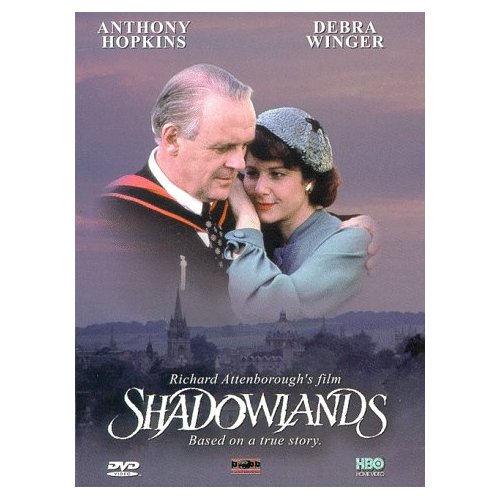
Shadowlands

A couple days ago, I watched the movie Shadowlands. The movie stars Anthony Hopkins, who plays Clive Staples Lewis, or Jack as his friends called him. This biography of sorts, focuses on Lewis' relationship with Joy Greshem, an American woman who first was merely a fan and pen-pal but later became a beloved wife to Jack.

I had heard that Shadowlands was a good movie and am happy to say that I was not disappointed. I have read quite a bit about C.S. Lewis and found the movie to be very accurate. Hopkins was at the top of his game, portraying the extremely intelligent and reserved Lewis. On par with Hopkins was Debra Winger, who played Joy Greshem.

A very interesting thing about the movie was that it gives viewers a glimpse into the extremely intellectual and scholarly environment that Lewis lived and worked in at Oxford University. It was just really neat to see the environment that C.S. Lewis lived and worked in and how "things were done" at that time.

I don't want to give away the story (though even the most rudimentary research into the life of Lewis would reveal the climax of the movie), but I was especially impressed by Hopkins' portrayal of the extremely grief stricken Jack, who is dealing with the truth of God's sovereignty even over circumstances that cause His children much pain. We see C.S. Lewis as a fallible man; as a person who, when presented with suffering, must either run from God in anger or run to Him in humility.

In his book The Problem of Pain, Lewis writes, "God whispers to us in our pleasures, speaks in our conscience, but shouts in our pain: it is a megaphone to rouse a deaf world." If only we, when confronted with pain and suffering, would cry out to God "What do you want me to learn from this Lord? Teach me to rely on you for everything my Father!" instead of "God, why are you doing this to me? Why couldn't you just give me a comfortable life and leave me alone?"

God has spared me from serious suffering in my short life thus far. For that I am thankful and I praise God. However, I do expect it someday. It is one of God's most power methods for drawing us closer to Himself. And that is our goal, is it not? To be conformed into the image of Christ, entering into a deeper and deeper relationship with Him every day? If so, we should not fear and dread pain, but instead embrace it when it comes. This does not mean that we go looking for it, but instead we look for God in suffering, rejoicing that we are being "purified by fire," drawing closer to the righteousness that we already have in Christ (James 1:2-4).
"We are like blocks of stone, out of which the sculptor carves the forms of men. The blows of his chisel, which hurt us so much, are what makes us perfect." - C.S. Lewis

July 27, 2006

You Gotta Read It!

I just finished reading Robinson Crusoe and it is now one of my three favorite books ever. If you haven't read it, you must do so. It is relatively short and does not take much time to get through, but the story is engaging, the themes deep and important, and the evolution of the character very intriguing.

I read on the internet that Daniel Defoe wrote a couple sequals to Crusoe, but that they were never as popular as the original. Some day I may check these out, but right now I have my hands full with another spectacular book...

I am now reading Journey to the Center of the Earth and am liking it a ton! The first thing that struck me was how funny it is! Sarcasm and dry humor abound! I listened to an unabridged audio book of Verne's The Time Machine which was very interesting, but not funny like Journey, so I was kind of suprised by Journey. I am only on the seventh chapter, where the Professor and Harry have just reached Iceland and are preparing to enter the dormant volcanoe and begin their long, downward journey. I can't wait to keep reading!

Next Friday, I leave with a friend and my dad to southern Colorado to meet up with some of my uncles for a week long backpacking trip up Blanca Mountain. I cannot wait to get going on this trip - it is tons of fun! Plus, it is the only chance I get to smoke a good cigar every once in a while.

June 06, 2006

55 Volumes of Pure Bliss

Well, just a few days ago I celebrated my 19th birthday. Hurray for me! My mom made me a chocolate cake and my family sang "Happy Birthday" to me. Then they had me sit down and “unwrap” (more like “pull a blanket off”) a large box. A mini-fridge! It will certainly come in handy next year at Moody and until then, I think I might put it up in my room. Because my dad has this phobia against air conditioning (I’ve tried to get him to seek help), I have devised an ingenious way to cool down my scorching room. I will plug in my new mini-fridge, open its door and then put my window fan in front of the opening, sucking out the cold air and blowing it into my oven of a room. Genius!

My sister kind of forgot to get me something by Wednesday (my birthday), but soon recovered by getting me the movie Kingdom of Heaven. It’s a sweet movie! I especially like the historical commentary feature, which lets you watch the movie while relevant historical facts about people and places pop up at the bottom of the screen. It’s actually quite interesting!

And then my birthday was over….or so I thought. Just yesterday, I was looking through the mail and saw a small cardboard package addressed to my dad. I didn’t really think anything of it (he gets a lot of books). But then he gave it to me, saying, “Happy Birthday!” Well, it turns out that they also got me The Complete Works of Martin Luther on CD and it is nothing short of amazing! I am not joking when I say it is one of the best presents I have ever received!

Fiftey-five volumes of pure bliss. That’s right – the CD contains fifty-five volumes of Luther’s works, ranging from commentaries on Genesis, to many of his Reformation writings, to the supremely interesting book entitled Table Talk (a collection of random thoughts and quotes by Luther, recorded by the many guests who stayed with him and ate at his table over the years). In all honesty, it is quite overwhelming. It will take years to work through all the material contained on that one little CD. Over the past few months I have really grown to like Luther a lot, and was planning on buying a few of his classics (like The Bon.dage of the Will), but after reading Here I Stand, a biography on Luther which included many quotes from Luther’s sermons and letters, I realized that there is much more to Luther than just his major, published works. I am especially looking forward to reading Luther’s commentary on Genesis. I read a small section from this commentary (it was about Abraham almost sacrificing Isaac) in Here I Stand and found Luther’s insights and thoughts to be wonderful (I will try to find this again and post it)!

There are also comprehensive introductions by the editors at the beginning of every volume. The introductions are all rather long, giving a lot of good historical and contextual information. They explain the circumstances surrounding the writing of the work, who the original audience was, etc. They also give information on how the pieces were translated from German (and sometimes Latin) into English.

Probably the feature that I find most helpful is the integrated footnote system. All one must do is hover their mouse over any footnote, and the information for that footnote will appear in a pop-up bubble. Many names and places are “footnoted” as well, displaying additional biographical and contextual information. And as if that wasn't enough, every single Bible reference, in ALL 55 volumes, is “footnoted” – just move your cursor over the reference and a pop-up will appear showing you the whole verse. I like.

There are many other great things about this program (bookmarks, advanced searching, extensive note taking system, citation system etc) but they are just icing on the cake. I do have one complaint, however. It was a pain to install. Because you are actually only buying book licenses, the core software is free and can be downloaded online. At first I used the CD, but it contained outdated software and just made the whole process take forever (update after update after update). However, once I got the stupid thing installed, it all worked perfectly.

I would definitely recommend this awesome resource to anyone who finds themselves attracted to Luther’s writing. Yes, it is rather pricey (about $150 on Amazon), but I think it will be worth it, and it is WAY cheaper than buying all 55 of those volumes in book form. Here you get 55 indexed, searchable, compact (you don’t even need the CD!), footnoted, copy/pasteable, and backupable books written by one of the greatest Christian thinkers in history.

Like I said…pure bliss.

May 15, 2006

School's Out for Summer!

Ok, it actually has been out for me for about two weeks now, but it's just now setting in. I keep waking up in the morning stressing about some forgotten paper or neglected lab. But alas, that's all over for a few months.

A few days ago I got a job working at the Pipac Center. I set up tables and chairs and anything else that they want me to set up for weddings, parties, chess tournaments etc. It's been pretty good so far. Although it's pretty mindless work, the people there are pretty cool and my manager is really easy going. It sure beats standing at a cash register for eight hours...

On a different note, I finally finished reading my second biography on Martin Luther, Here I Stand, by Roland H. Bainton. It was far better than the first book I read by Martin Marty (it was about three times longer as well). The book gave much more information on the circumstances and events throughout Germany and Europe during Luther's days, adding a much richer and full context to the story of the rebellious little monk from Wittenberg. One thing that I really liked about Here I Stand, as opposed to Martin Luther, was that Bainton quoted much more of Luther than did Marty. Almost every page had a quote on it, and many were very long. After reading through the book, I am now determined to read more of Luther's work (not just his published works like The Bon dage of the Will etc. but also his sermons and letters). Luther has a way with words that reminds me of C.S. Lewis. Although Luther is much harsher, direct and unrestrained with his words than Lewis ever was, Luther, like Lewis, has a unique ability to choose specific words to get his point across in the most precise and understandable way possible. Many times, after reading Luther, I nod my head in agreement and exclaim, "That's exactly what I was thinking!" (sometimes I do this aloud...luckily I am alone most of the time). However, at other times Luther's thoughts and insights are refreshingly new to me, causing me to look at an idea or passage about God in a totally new way. He is truly refreshing to read. And, as I mentioned in an earlier post, he loved the Word. His love for the Word is amazingly evident in all of his writings. In his preface to the book of Romans, Luther demonstrates his love for Scripture clearly when he says,
It is well worth a Christian's while not only to memorize [Romans] word for word but also to occupy himself with it daily, as though it were the daily bread of the soul. It is impossible to read or to meditate on this letter too much or too well. The more one deals with it, the more precious it becomes and the better it tastes. Therefore I want to carry out my service and, with this preface, provide an introduction to the letter, insofar as God gives me the ability, so that every one can gain the fullest possible understanding of it. Up to now it has been darkened by glosses and by many a useless comment, but it is in itself a bright light, almost bright enough to illumine the entire Scripture.
I am forever thankful to God that He has given me an ever growing love for His Word (it is such an inadequate and pathetic love). Luther is absolutely right when he says, "the more one deals with it, the more precious it becomes and the better it tastes." I am rereading so many passages and I am finding that they seem new and fresh every time I read them. The Word is rich and full of God and cannot be exhausted. Luther is right: It is impossible to read or meditate on God's Word too much.

Now I have begun reading Jonathan Edwards' The Religious Affections. I have to say, Edwards is not as enjoyable to read as Luther is. His writing skills are not nearly what Luther's are (and his run-on sentences are killer!). However, Edwards has his moments...and in these moments he shines.
I am bold to assert, that there never was any considerable change wrought in the mind or conversation of any one person, by anything of a religious nature, that ever he read, heard or saw, that had not his affections moved. Never was a natural man engaged earnestly to seek his salvation: never were any such brought to cry after wisdom, and lift up their voice for understanding, and to wrestle with God in prayer for mercy; and never was one humbled, and brought to the foot of God, from anything that ever he heard or imagined of his own unworthiness and undeservings of God’s displeasure; nor was ever one induced to fly for refuge unto Christ, while his heart remained unaffected. Nor was there ever a saint awakened out of a cold, lifeless frame, or recovered from a declining state in religion, and brought back from a lamentable departure from God, without having his heart affected. And in a word, there never was anything considerable brought to pass in the heart or life of any man living, by the things of religion, that had not his heart deeply affected by those things.
Later he says,
If the great things of religion are rightly understood, they will affect the heart. The reason why men are not affected by such infinitely great, important, glorious, and wonderful things, as they often hear and read of, in the Word of God, is undoubtedly because they are blind; if they were not so, it would be impossible, and utterly inconsistent with human nature, that their hearts should be otherwise, than strongly impressed, and greatly moved by such things.
I said Edwards has "moments." However, this is not to say that most of what Edwards has written is bad or worthless. On the contrary, Edwards is very, very good. He can be much more profound than Luther at times. The Religious Affections is an amazing book, packed full of biblical truth. It just takes more work than much of Luther's stuff. His writing is hard to work through at times (most of the time). But this is not a count against him. Edwards is worth the work.

Well, I have spent far too much time writing this post and its time for supper. Later.

April 03, 2006

Martin Luther and the Word

Currently, the poll about favorite theologians shows that Marin Luther is at the top of the list. I would have to concur. Ever since seeing the movie Luther and reading John Piper's book The Legacy of Sovereign Joy, I have become fascinated by Martin Luther. Since finishing The Legacy (which is actually about three different men), I have read many other articles on the internet and one biography of Luther (I plan on reading more). The book I just finished was written by Martin Marty (I laughed) and was simply titled Martin Luther. Apart from being just plain interesting reading, I was really struck by one thing in Luther that made him one of the greatest reformers (if not the greatest).

Luther was utterly devoted to the Word. This point cannot be stressed enough. Luther accepted the Bible and only the Bible as absolute authority, boldly rejecting the edicts and councils of the Church and Pope when they contradicted Scripture. This profound and amazing rejection of the Church is hard to grasp if one does not have some knowledge about the Church and it's influence and importance in Europe during the 16th century.

In the 1500's the Church was everything. Salvation was found nowhere but in and through the Church. The word of the Pope was equal in authority to the Word of God - in fact it was more authoritative than the Word of God. In response to Luther's 95 Theses, Sylvester Prierias said, "He who does not accept the doctrine of the Church of Rome and pontiff of Rome as an infallible rule of faith, from which the Holy Scriptures, too, draw their strength and authority, is a heretic." In 1516, Pope Leo X declared, "It is necessary for the salvation of all souls that all Christian believers be subject to the pope at Rome." When Luther read the Word, he did not see where God had given authority to the "pope at Rome," but instead saw Christ as being the one and only "pope." Christ was the head and salvation was found in him and him alone.

However, this position was heretical. To deny the authority of the Church was to deny salvation (according to the Pope). When Luther would go to debate church officials about his heretical ideas, he would often be asked this question: How do you know you are right? How could centuries of Church doctrine and thousands of Church leaders have been wrong? Who are you, one man, to go against the Church of Rome? This was a question that Luther struggled with.

At the Diet of Worms, after being shown a table covered with all of Luther's heretical writings, Luther was asked if he would like to recant. In response to this question, Luther asked that he be allowed to have a day to think about it. At this, many of his supporters became discouraged, thinking that he was getting weak and would bow under the pressure of Rome. Indeed the weight of Rome was heavy - Who was he to reject centuries of Church doctrine? However, because Luther was solely devoted to the Word, he returned to the diet the next day and boldly declared, “Unless I am convinced by the testimony of the Scriptures or by clear reason (for I do not trust either in the Pope or in the councils alone, since it is well known that they have often erred and contradicted themselves), I am bound by the Scriptures I have quoted and my conscience is captive to the Word of God. I cannot and I will not retract anything, since it is neither safe nor right to go against conscience.” For this statement, Luther was excommunicated and put under imperial ban, but his faith was in Christ and therefore his salvation was sure.

We should all pray that God would give us a love for His Word and a devotion to it like the love and devotion that Luther had - one that eclipses all other loves and all other devotion. The Word of God is the mean that God has ordained to reveal Himself to us through. In short, it is how we know God. We cannot find God in any other way. Luther knew this. His faith in, and love for, the Word drove him to hold it higher than anything else. We must do this as well. Pray for God's grace that you might glorify His Word always.

January 02, 2006

The Martyr's Song


Sing O son of Zion.
Shout O child of mine.
Rejoice with all your heart and soul and mind.
I’ve been waiting to dance with you in fields full of colors you have never seen…


This is the beginning of The Martyr’s Song by Todd Agnew. He co wrote the song with Ted Dekker to go along with Ted Dekker’s new book with the same name: The Martyr’s Song.

The Martyr’s song is one of the most powerful books I have read in a long time. It opens with a mysterious lady named Eve, who desires to make a plain and in all honesty ugly, beautiful. Soon Eve begins to tell us the story of a small Bosnian village and their struggle with evil. The story is brutal and violent but it is also beautiful and filled with hope. People are beaten and killed but their deaths are simultaneously enormously sad and wonderfully joyous occasions. This book looks at the face of death but then masterfully demonstrates how Christ defeated death when He died on that cross and then rose again.

1Co 15:53-57 For this perishable body must put on the imperishable, and this mortal body must put on immortality. (54) When the perishable puts on the imperishable, and the mortal puts on immortality, then shall come to pass the saying that is written: "Death is swallowed up in victory." (55) "O death, where is your victory? O death, where is your sting?" (56) The sting of death is sin, and the power of sin is the law. (57) But thanks be to God, who gives us the victory through our Lord Jesus Christ.

Dekker said in an interview that he started writing this book after a death in his own family. He began questioning how real his belief in a life after death really was. I think that is a question that we must all ask ourselves. Do we truly eagerly await the day that we will die; the day that we will be forever united with our Father? Paul believed this with all his heart which is why he said, “For to me to live is Christ, and to die is gain.” (Phil. 1:21).

Now, let me be clear. Death itself is not what is so great. Death was the result of sin; it is a curse. Jesus wept (not just cried but wept) when His friend Lazarus died, but not because He was sad for Lazarus! As many of you know, Jesus later raised Lazarus from the dead. As the great Christian author C.S. Lewis put it after he went into a coma and almost died, “Tho’ I am by no means unhappy I can’t help feeling it was rather a pity I did revive in July. I mean, having been glided so painlessly up to the Gate it seems hard to have it shut in one’s face and know that the whole process must be some day gone through again…Poor Lazarus!”

Many times I seem to forget the wonderful life that awaits me when I die. Death should not be dreaded – why would we dread our homecoming?! Death is merely the door to a new life. It is the new and wonderful life that comes after death that we, who are in Christ, look forward to. Indeed death for the sinner and the saint is the same. It is that which looms after death for each one that causes one to fear death above all other things and the other to eagerly await it above all other things. Lewis stated this very well when he said, “If we really believe what we say we believe - if we really think that home is elsewhere and that this life is a ‘wandering to find home’, why should we not look forward to the arrival?”

Lord, help us to faithfully look forward to the day that we are perfectly united with You for all eternity.

Sing O son of Zion.
Shout O child of mine.
Dance with all the strength that you can find,
For you are finally home.